


Body Grief: The Seven Stages of Grieving a Changing Body
There’s a term that I’ve been using a lot lately to help name, normalize, and validate what my clients are experiencing. It’s grief.
Not the grief we associate with death or other palpable, physical losses, but a quieter, more nebulous grief. The grief of living in a body that keeps changing, aging, getting sick, healing “wrong,” gaining weight, losing capacity, or simply refusing to look or move the way it used to.
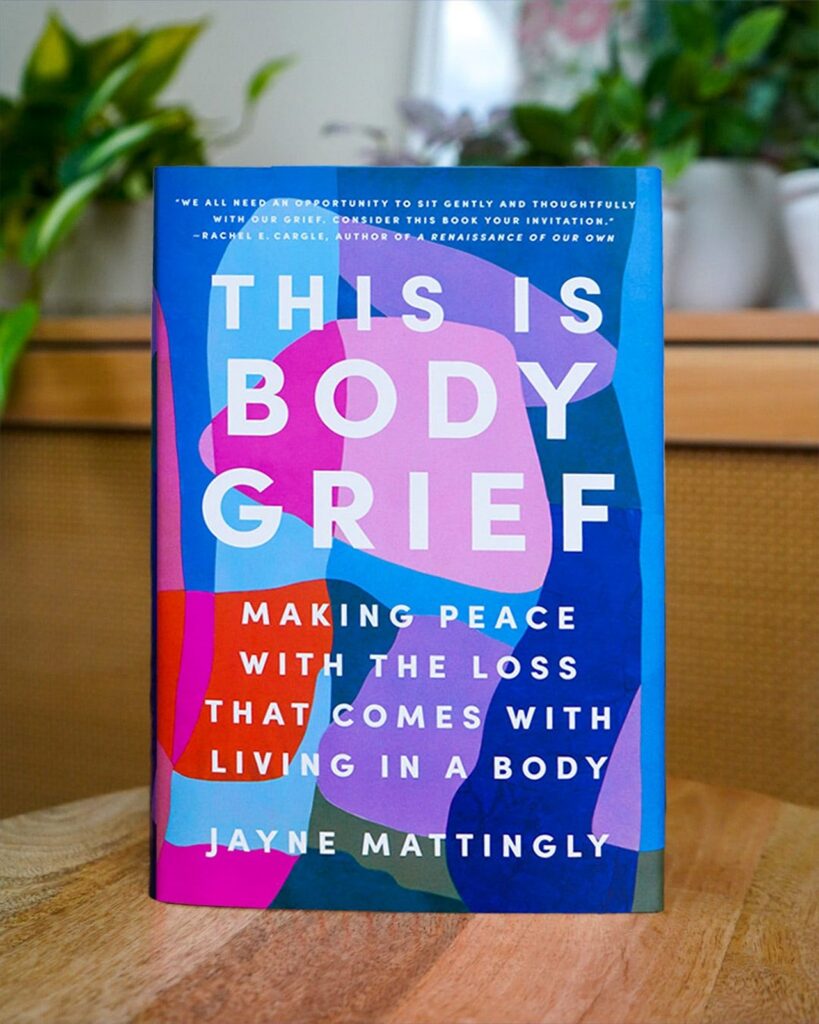
Author and eating disorder recovery coach Jayne Mattingly has a name for this. She calls it Body Grief, and after years of sitting with clients in individual therapy – people navigating eating disorder recovery, chronic illness, aging, disability, postpartum bodies, and midlife transitions – I think she’s onto something most of us have felt (or are feeling) and few of us have had language for.
What Is Body Grief?
Mattingly defines Body Grief as the grief we experience specifically because we live in a body, a body that changes whether we consent to it or not.
It shows up when puberty rearranges us without asking. It shows up in infertility, pregnancy loss, a new diagnosis, menopause, and the slow erosion of what our knees or backs used to be able to do. It shows up when we look in the mirror and don’t recognize what we see.
Unlike the more familiar stages of grief from Elizabeth Kübler-Ross, which were developed to describe the experience of terminally ill patients approaching death, Mattingly’s framework is built specifically around this experience of living, changing, and often disabled or ill bodies. It’s not a model borrowed and applied to body image as an afterthought. It was built for this.
And like all grief, Mattingly is clear that Body Grief isn’t something to be fixed or resolved on a schedule. It isn’t linear. It doesn’t finish tidily, with a bow on top. It’s something to be felt, honored, and moved through again and again, as the body keeps changing and asking new things of us.
The Seven Stages
Mattingly outlines seven stages of Body Grief: dismissal, shock, apology, fault, fight, hopelessness and hope, and eventual body trust. Let’s look at those a little closer.
Stage 1: Dismissal
Dismissal, says Mattingly, is when we “try to stay in control of the narrative about what’s happening to and in our bodies that we can’t make sense of.”
It may sound a lot like the memes: I’m fine, it’s fine, everything is fine (as a dumpster fire rages nearby). But ultimately, dismissal is a response to fear. If we acknowledge what’s happening, it’s real. And if it’s real, we have to face it, including all the things that are likely out of our control.

Dismissal can also come from other people: “There’s nothing wrong with you,” “It’s all in your head,” or “But you look so good!”
Mattingly suggests two ways to begin moving through dismissal:
- Practice Body Residency, which is acknowledging that your body is your “forever home,” whether you’re content in it or not. Meditation, breathwork, body scans, intuitive eating, or some chair yoga can all help you become more aware of how your body feels.
- Activate Your Inner Advocate. Name what you’re experiencing, out loud if that’s helpful. Some language Mattingly offers is: Something isn’t right, and I believe my body and My experience is real and valid.
Stage 2: Shock
Shock arrives when dismissal is no longer “working,” when it’s no longer possible to ignore the reality of the experience.
Mattingly calls it “the embodiment of a reality check.” It can be triggered by a diagnosis, an injury, or something seemingly smaller, like no longer fitting into a favorite pair of pants. It forces us to recognize that our body is no longer what it used to be.
Oof. Ain’t that a kick in the head.
Shock can also trigger a stress response, making it difficult to think clearly about what comes next. Mattingly suggests:
- Adjust your expectations, what she calls “shifting down your perspective.” The goal isn’t to give up, but to make room for the reality you’re actually facing.
- Breathe into your new normal. Intentional breathing can help regulate the stress response and bring you back into the present.
- Feel your feelings. The emotions that come with shock can be scary, but they also carry information about what’s happening, what you care about, and what you’re afraid of. Feelings aren’t facts, but pushing them away doesn’t make them disappear.
Stage 3: Apology
Apology is the stage where you start apologizing on your body’s behalf, for having needs, for taking up space, for not being what it “should” be.
It’s the point where grief turns into a kind of preemptive shrinking: instead of being angry at the body or the situation, you start acting as though your body’s very existence – its needs, its size, its limitations, its presence – is something that requires an apology to the people around it.
This stage reminds me of Sonya Renee Taylor’s book, The Body Is Not an Apology, in which she names the cultural machinery that manufactures this reflex in the first place, including systemic racism, ableism, ageism, and anti-fat bias.
There are three ways to begin moving through apology:
- Take up space. Wear clothes you actually like. Eat foods that you want. Nourish your body and allow it to exist without constantly trying to make it smaller or less noticeable.
- Find community in your body grief. Being with people who understand can help interrupt the feeling that you’re uniquely failing at something everyone else has figured out.
- Reframe the story. Notice the thoughts that turn body discomfort into shame or self-punishment. I’m too much. I must make myself smaller is a very different story from This is my body today, and I don’t owe the world an explanation for my appearance.
Stage 4: Fault
Fault is the stage where grief goes looking for a reason. It sounds like “why is this happening to me?” or “I just need to find the fix.” Mattingly connects this stage to internalized ableism and shame, that is, the sense that if something is wrong with your body, it must be because you did (or failed to do) something. It’s less about blaming the world and more about blaming yourself, quietly, for a body that was never fully within your control to begin with.
Importantly, this is where Mattingly calls out the role of misogyny, racism, homophobia, transphobia, weight stigma, and the other -isms that people grapple with daily. She notes that, when these are facts of life for an individual, then the fault lies squarely with these systems of oppression. “Except for the experience of living with actual physical pain, Body Grief only exists in relation to the way our body is perceived in society and how this impacts our choices and the way we are treated.”
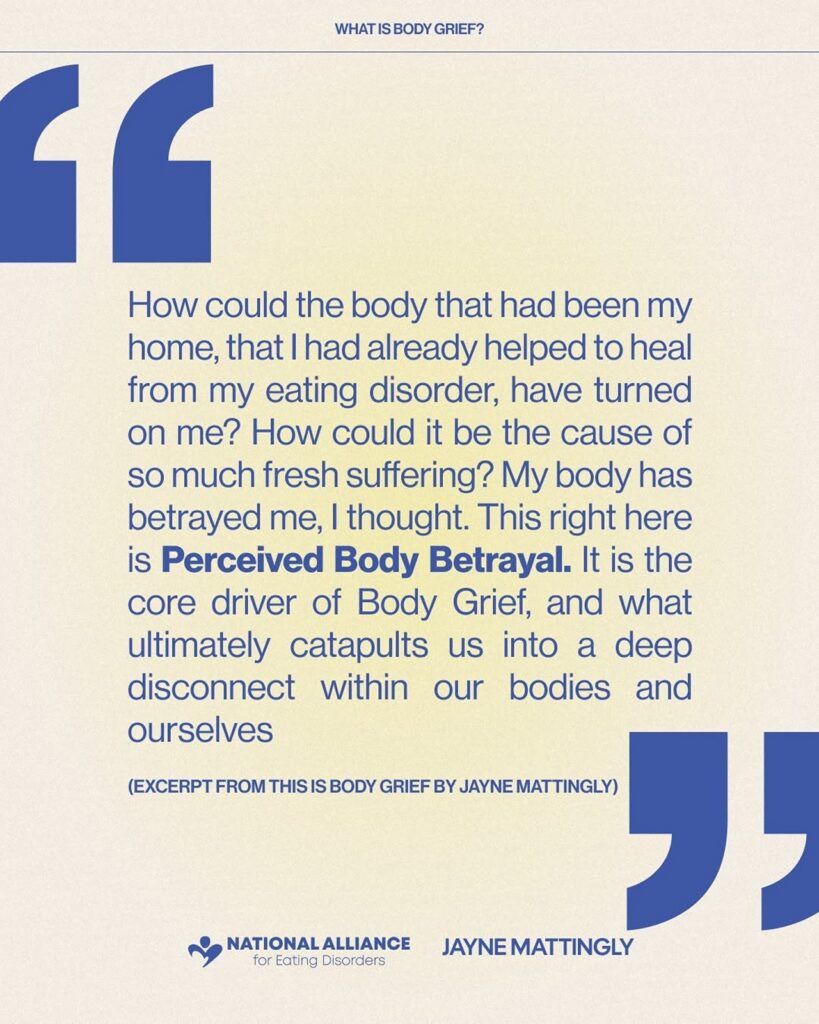
AND, even still, Mattingly says that the key to preventing Fault from becoming “our toxic default response to our pain and suffering” is to remember – over and over again – that no one thing is ever solely to blame for how things are. “Some things just are.”
To move through fault, Mattingly suggests:
- Tap into “healthy rage.” Anger can be scary, but if you approach it with curiosity, you may find that it tells you something important about what you need and where you may need to act.
- Move from “why me?” to “what now?” Feeling your feelings doesn’t mean staying stuck in them. It means noticing, naming, feeling, and then moving through them.
- Zoom out. As intense as your distress may be, remembering that life is bigger than you can be powerful and perspective-shifting. We are part of something grander and – both comfortingly and frustratingly – more mysterious, whether that’s family, faith, art, vocation, or community.
Stage 5: Fight
Fight is grief in overdrive…when you’re fully aware something has changed, but determined not to let it slow you down. This can look like overworking, staying busy, dissociating, or otherwise numbing out. It’s the stage that often gets mistaken for resilience or strength, because from the outside it looks like healthy coping. But from the inside, it’s usually exhaustion or fear in a fancy “productive and powerful” outfit.
Moving through fight, says Mattingly, means “choosing your battles.” Specifically:
- Dismantle your unicorn complex, that is, the belief that you are the exception to the rule, that you are stronger than other people or somehow invulnerable to being human. But we are not unicorns. We are human.
- Give up the fight. What would it look like to take a breath? To move towards rest? To ask for help? There is a path of
leastless resistance available to you, unfamiliar though it may be. - Address your envy. Envy can show you what you want, but it can also keep you in the fight. Gratitude can help, as can boundaries or putting guardrails around things that keep you stuck in comparison (looking at you, Instagram!).
- Embrace the joy of missing out (JOMO). You don’t have to say yes to everything, and your life doesn’t have to look like everyone else’s. This is about getting clear on what you actually want, what your unique body needs, and what your true capacity is.
Stage 6: Hopelessness and Hope
Mattingly pairs these two deliberately. She’s clear that hopelessness can’t exist without hope, and vice versa. Hopelessness is the despair of the process, a normal (if brutal) part of grieving a body that keeps changing. Hope is described as the last bit of light visible from the bottom of it.
Rather than treating hope as the “positive” stage you graduate into once hopelessness is done, she frames them as co-occurring; you can be in despair and still be reaching toward something at the same time.
This movement may be supported by a few practices, including:
- Identify your anchors. I talk to folks about anchors all the time: those people, places, and things that give your life meaning and tether you to the world and your meaningful human experience no matter how hopeless things get. This could be your family, but it could also be your morning cup of coffee in the special mug, or the way your kid’s head smells after a bath, or the relief in taking off your bra at the end of the day.
- Find a body grief role model. These days, I find myself drawn to any older woman with wrinkles. Bonus points if she wears clothes that are comfortable and seems unashamed to take up a little space. A role model is someone you can learn from and lean on symbolically and emotionally to show you the way through this messiness.
And then, at some point, this practice can evolve from finding a body grief role model to becoming a body grief role model, helping you not only find hope in hopelessness but also a profound sense of purpose.
Stage 7: Body Trust
The final stage, Mattingly defines body trust simply as the acknowledgment that you and your body are on the same team. Not that the body has been “fixed” or returned to some earlier state, but that the adversarial relationship has ended.
It’s less a destination than a returning: the recognition that your body was never against you in the first place, even in the middle of all seven stages.
Mattingly is careful to note that building body trust is never-ending, because having a body is ever-evolving. And so she presents the following practices as evergreen:
- Practice true self-care. Self-care is not an indulgence or an escape – an expensive trip to the spa or a fancy line of skincare. True self-care helps you stay in the present with greater ease and meaning. As Mattingly puts it, it’s “laying down a cushion on the good days so that on the not-so-good days you have something to fall back on.”
- Regulate your nervous system. Grief can wreak havoc on the nervous system. Breathing, stretching, humming, and even changing your physical environment can help you notice and respond to what your body needs.
- Trust others. Developing body trust with ourselves can help us develop trust in others, and vice versa. We don’t have to navigate Body Grief alone.
- Surrender the need for control. She ends with the easy one. Ha! Nope. Surrender is terrifying, especially for a body that is already doing hard things, and Mattingly names that it often isn’t feasible or safe to surrender before you are ready. That’s why it’s last. Ultimately, though, letting go of what we cannot control can make room for the felt experience of okayness, peace, and trust.
Why This Matters in Individual Therapy
Okay, whew. That got much longer than I intended!
But part of what draws me to this framework is how much room it makes for what I often think of as the messy middle. So much of the language we’re handed around bodies is binary: good/bad, healthy/unhealthy, before/after. None of it leaves much room for grief, ambivalence, anger, relief, fear, or the reality that sometimes we’re both adapting to our bodies and wishing things were different.
And even once we’ve gotten through one thing in this process, we’re being challenged by a new thing, or by the old thing in a new way. It’s circuitous and unpredictable and, well, messy.
In individual therapy, I see Body Grief show up constantly, even when nobody names it that way. It’s there in the person white-knuckling their way through eating disorder recovery and grieving the body they thought they’d have on the other side. It’s there in the person moving through perimenopause who feels betrayed by a body that no longer sleeps, regulates temperature, or carries weight the way it used to.
It’s there in chronic illness, disability, injury, postpartum changes, aging, and all the other moments when the body we have diverges from the body we expected to have—or the body that society tells us we’re allowed to have.
Naming this experience as grief, rather than as a personal failing, a motivation problem, or something that needs to be positively reframed away, can be a profound shift.
Grief gets to be messy. Grief doesn’t have to move in a straight line. Sometimes you feel acceptance in the morning and rage by dinner. Sometimes you think you’ve made peace with a change, only to find yourself grieving it all over again six months later.
That doesn’t mean you’re doing it wrong. It means you’re human, living in a body that continues to change.
How Individual Therapy Can Help With Body Grief
If you’re struggling with body changes, body image, eating disorder recovery, chronic illness, disability, perimenopause, or the complicated emotions that can come with aging, you don’t necessarily need another person to tell you how to feel about your body.
You may just need a place to actually feel what you’re feeling and make sense of it without judgment.
That’s where individual therapy can help.
In therapy, we can slow down enough to notice what’s underneath the urge to fix, control, hide, apologize for, or fight against your body. We might explore where body shame or fear came from, how diet culture and other cultural messages have shaped the way you relate to yourself, and what it would look like to build a different relationship with your body—one rooted in self-trust rather than punishment or control.
Sometimes that means grieving the body you had. Sometimes it means grieving the body you expected to have. Sometimes it means working through the fear of what your changing body might mean for your relationships, your identity, your sexuality, your work, or your sense of who you are. And sometimes it means learning how to care for a body that doesn’t feel particularly trustworthy or cooperative right now.
You don’t have to love your body. You don’t have to feel grateful for every change. And you don’t have to rush toward acceptance.
You can start somewhere much more manageable: learning to listen to yourself, make room for what you’re experiencing, and build trust with the body you actually have.
If you’re looking for individual therapy for body image concerns, eating disorder recovery, body grief, or navigating a changing body, this is work I would be honored to do with you. 💛


Be the first to comment